Characteristics of Store-and-Forward Ethernet Switching
This section provides an overview of the functions and features of store-and-forward Ethernet switches.
Error Checking Figure
1 shows a store-and-forward switch receiving an Ethernet frame in its
entirety. At the end of that frame, the switch will compare the last
field of the datagram against its own frame-check-sequence (FCS)
calculations, to help ensure that the packet is free of physical and
data-link errors. The switch then performs the forwarding process.
Whereas
a store-and-forward switch drops invalid packets, cut-through devices
forward them because they do not get a chance to evaluate the FCS before
transmitting the packet.
Figure 1. Ethernet Frame Entering a Store-and-Forward Bridge or Switch (from Left to Right) 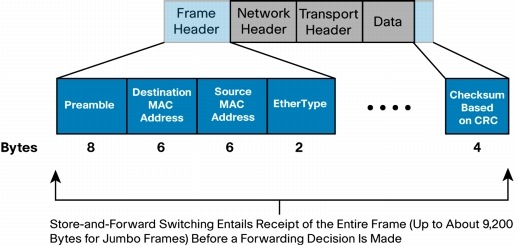 Automatic Buffering The
process of storing and then forwarding allows the switch to handle a
number of networking conditions simply by the way it operates.
The
ingress buffering process that a store-and-forward switch performs
provides the flexibility to support any mix of Ethernet speeds, starting
with 10 Mbps. For example, handling an incoming frame to a 1-Gbps
Ethernet port that needs to be sent out a 10-Gbps interface is a fairly
straightforward process. The forwarding process is made easier by the
fact that the switch's architecture stores the entire packet.
Access Control Lists Because a store-and-forward switch stores the entire packet in a buffer2,
it does not have to execute additional ASIC or FPGA code to evaluate
the packet against an access control list (ACL). The packet is already
there, so the switch can examine the pertinent portions to permit or
deny that frame.
|
手机版|小黑屋|BC Morning Website ( Best Deal Inc. 001 )
GMT-8, 2025-12-14 01:07 , Processed in 0.014177 second(s), 17 queries .
Supported by Best Deal Online X3.5
© 2001-2025 Discuz! Team.