Characteristics of Cut-Through Ethernet Switching
This
section explores cut-through Ethernet switching. Because cut-through
switching is not as well understood as store-and-forward switching, it
is described in more detail than the store-and-forward technology.
Invalid Packets
Unlike
store-and-forward switching, cut-through switching flags but does not
get a chance to drop invalid packets. Packets with physical- or
data-link-layer errors will get forwarded to other segments of the
network. Then, at the receiving end, the host invalidates the FCS of the
packet and drops the packet.
Timing of Cut-Through Forwarding
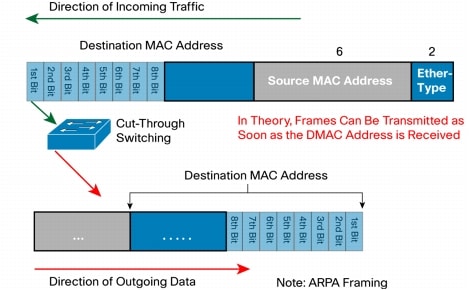
In
theory, as indicated in Figure 2, a cut-through switch can make a
forwarding decision as soon as it has looked up the DMAC address of the
data packet. The switch does not have to wait for the rest of the packet
to make its forwarding decision.
However,
newer cut-through switches do not necessarily take this approach. A
cut-through switch may parse an incoming packet until it has collected
enough information from the frame content. It can then make a more
sophisticated forwarding decision, matching the richness of
packet-handling features that store-and-forward switches have offered
over the past 15 years.
Figure 2.
Cut-Through Ethernet Switching: in theory, frames are forwarded as soon
as the switch receives the DMAC address, but in reality, several more
bytes arrive before forwarding commences
EtherType Field
In
preparation for a forwarding decision, a cut-through switch can fetch a
predetermined number of bytes based on the value in EtherType field,
regardless of the number of fields that the switch needs to examine. For
example, upon recognizing an incoming packet as an IPv4 unicast
datagram, a cut-through switch checks for the presence of a filtering
configuration on the interface, and if there is one, the cut-through
switch waits an additional few microseconds or nanoseconds to receive
the IP and transport-layer headers (20 bytes for a standard IPv4 header
plus another 20 bytes for the TCP section, or 8 bytes if the transport
protocol is UDP). If the interface does not have an ACL for traffic to
be matched against, the cut-through switch may wait for only the IP
header and then proceed with the forwarding process. Alternatively, in a
simpler ASIC implementation, the switch fetches the whole IPv4 and
transport-layer headers and hence receives a total of 54 bytes up to
that point, irrespective of the configuration. The cut-through switch
can then run the packet through a policy engine that will check against
ACLs and perhaps a quality-of-service (QoS) configuration.
Wait Time
With
today's MAC controllers, ASICs, and ternary content addressable memory
(TCAM), a cut-through switch can quickly decide whether it needs to
examine a larger portion of the packet headers. It can parse past the
first 14 bytes (the SMAC, DMAC, and EtherType) and handle, for example,
40 additional bytes in order to perform more sophisticated functions
relative to IPv4 Layer 3 and 4 headers. At 10 Gbps, it may take
approximately an additional 100 nanoseconds to receive the 40 bytes of
the IPv4 and transport headers. In the context of a task-to-task (or
process-to-process or even application-to-application) latency
requirement that falls in a broad range, down to a demanding 10
microseconds for the vast majority of applications, that additional wait
time is irrelevant. ASIC code paths are less complex when IP frames are
parsed up to the transport-layer header with an insignificant latency
penalty.
Advantages of Cut-Through Ethernet Switching
A
primary advantage of cut-through switches is that the amount of time
the switch takes to start forwarding the packet (referred to as the
switch's latency) is on the order of a few microseconds only, regardless
of the packet size. If an application uses 9000-byte frames, a
cut-through switch will forward the frame (if that is the appropriate
decision to make for that datagram) a few microseconds to a few
milliseconds earlier than its store-and-forward counterpart (a few
microseconds earlier in the case of 10-Gbps Ethernet).
Furthermore,
cut-through switches are more appropriate for extremely demanding
high-performance computing (HPC) applications that require
process-to-process latencies of 10 microseconds or less.
In some scenarios, however, cut-through switches lose their advantages.
Windowed Protocols and Increased Response Time
Even
where the cut-through methodology can be used, windowed protocols (such
as TCP) can increase end-to-end response time, reducing the
effectiveness of the lower switching delay of cut-through switching and
making the latency of store-and-forward switches essentially the same as
that of cut-through switches.
User Perception of Response Times with Most Applications
In
most enterprise environments, including the data center, users do not
notice a difference in response times whether their environment is
supported with store-and-forward or cut-through switches.
For
example, users requesting a file from a server (through FTP or HTTP) do
not notice whether the reception of the beginning of the file is
delayed by a few hundred microseconds. Furthermore, end-to-end latencies
for most applications are in the tens of milliseconds. For instance, an
application latency of about 20 milliseconds on a cut-through or
store-and-forward switch that has a 20-microsecond latency (which would
be 1/1000 of the application latency) is negligible.
|