Why Has Cisco Brought Back Cut-Through Ethernet Switching?
Unlike
in the 1980s and 1990s, when store-and-forward switches were more than
adequate to handle application, host OS, and NIC requirements, today's
data centers often include applications that can benefit from the lower
latencies of cut-through switching, and other applications will benefit
from consistent delivery of packets that is independent of packet size.
Cisco's
successful experience with cut-through and low-latency
store-and-forward switching implementations over several years, coupled
with flexibility and performance advancements in ASIC design, have made
possible cut-through switching functions that are much more
sophisticated than those of the early 1990s. For example, today's
cut-through switches provide functions for better load balancing on
PortChannels, permitting and denying data packets based on fields that
are deeper inside the packet (for example, IP ACLs that use IP addresses
and TCP/UDP port numbers, which used to be difficult to implement in
hardware while performing cut-through forwarding).
In
addition, Cisco switches can mitigate head-of-line (HOL) blocking by
providing virtual output queue (VOQ) capabilities. With VOQ
implementations, packets destined to a host through an available egress
port do not have to wait until the HOL packet is scheduled out.
These
factors have allowed Cisco to introduce the Cisco Nexus 5000 Series
Switches: low-latency cut-through switches with features comparable to
those of store-and-forward switches.
Cut-Through Switching in Today's Data Center As
explained earlier, advancements in ASIC capabilities and performance
characteristics have made it possible to reintroduce cut-through
switches but with more sophisticated features.
Advancements
in application development and enhancements to operating systems and
NIC capabilities have provided the remaining pieces that make reduction
in packet transaction time possible from application to application or
task to task, to fewer than 10 microseconds. Tools such as Remote Direct
Memory Access (RDMA) 4 and host OS kernel bypass5
present legitimate opportunities in a few enterprise application
environments that can take advantage of the functional and performance
characteristics of cut-through Ethernet switches that have latencies of
about 2 or 3 microseconds.
Ethernet switches with low-latency characteristics are especially important in HPC environments.
Latency Requirements and High-Performance Computing HPC,
also known as technical computing, involves the clustering of commodity
servers to form a larger, virtual machine for engineering,
manufacturing, research, and data mining applications.
HPC
design is devoted to development of parallel processing algorithms and
software, with programs that can be divided into smaller pieces of code
and distributed across servers so that each piece can be executed
simultaneously. This computing paradigm divides a task and its data into
discrete subtasks and distributes these among processors.
At
the core of parallel computing is message passing, which enables
processes to exchange information. Data is scattered to individual
processors for computation and then gathered to compute the final
result.
Most
true HPC scenarios call for application-to-application latency
characteristics of around 10 microseconds. Well-designed cut-through as
well as a few store-and-forward Layer 2 switches with latencies of 3
microseconds can satisfy those requirements.
A
few environments have applications that have ultra-low end-to-end
latency requirements, usually in the 2-microsecond range. For those rare
scenarios, InfiniBand technology should be considered, as it is in use
in production networks and is meeting the requirements of very demanding
applications.
HPC applications fall into one of three categories:
• Tightly coupled applications: These applications are characterized by their significant interprocessor communication (IPC) message exchanges among the computing nodes. Some tightly coupled applications are very latency sensitive (in the 2- to 10-microsecond range). • Loosely coupled applications: Applications in this category involve little or no IPC traffic among the computing nodes. Low latency is not a requirement. • Parametric execution applications: These applications have no IPC traffic. These applications are latency insensitive. The category of tightly coupled applications require switches with ultra-low-latency characteristics.
Enterprises that need HPC fall into the following broad categories:
• Petroleum: Oil and gas exploration • Manufacturing: Automotive and aerospace • Biosciences • Financial: Data mining and market modeling • University and government research institutions and laboratories • Climate and weather simulation: National Oceanic and Atmospheric Administration (NOAA), Weather Channel, etc. Figure 4 shows some HPC applications that are used across a number of industries.
Figure 4. Examples of HPC Applications 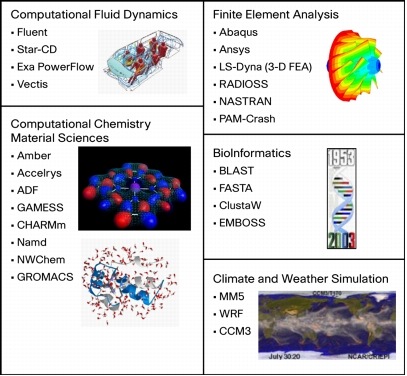 |
手机版|小黑屋|BC Morning Website ( Best Deal Inc. 001 )
GMT-8, 2025-12-14 01:07 , Processed in 0.013751 second(s), 17 queries .
Supported by Best Deal Online X3.5
© 2001-2025 Discuz! Team.