Weird title - puzzle? see the details
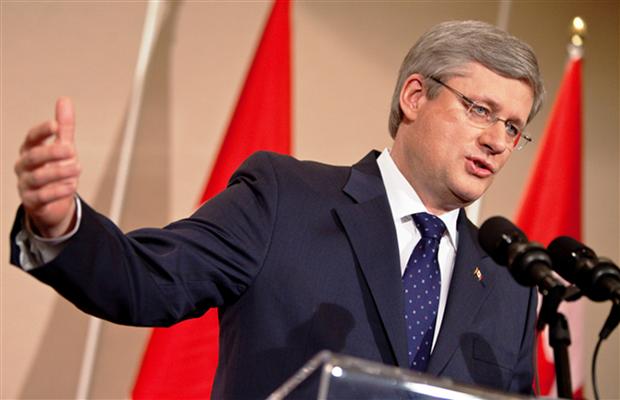
Prime Minister Stephen Harper has come under attack for saying that "Islamicism" poses the greatest security threat to Canada and for declaring that his government will give police broad new anti-terrorism powers that were stripped from them four years ago.Photograph by: Getty Images, Getty ImagesOTTAWA — Prime Minister Stephen Harper has come under attack for saying that "Islamicism" poses the greatest security threat to Canada and for declaring that his government will give police broad new anti-terrorism powers that were stripped from them four years ago. Harper made the comments in an interview with CBC broadcaster Peter Mansbridge to be televised Thursday night. Interim Liberal leader Bob Rae said Harper is putting too much focus on Islamic extremists without noting that there are terrorists from other backgrounds. "We don't have to single out just one," Rae told reporters Wednesday. "I think if you look at the outbursts of extremism around the world, I don't think that you can limit it to just one religion, or ideology or form of nationalism." And he said Harper should prove his case for why contentious measures — preventive arrests and investigative hearings — should be re-instituted. "Is the prime minister saying that for the last four or five years we have been at risk, at greater risk, because the measures have not been in place? I think he has to answer that question." NDP foreign affairs critic Paul Dewar said the upcoming 10th anniversary of 9/11 should be a "time for reflection" on how to build a "more inclusive society to end extremism." "Let's all guard against the knee-jerk demonizing and overheated rhetoric," said Dewar. "Unfortunately, Mr. Harper continues to use divisive language for political purposes." Dewar said the prime minister's plan to reintroduce the "draconian" anti-terrorist measures aren't backed up by the facts. "The government has produced no evidence to justify this move. Security is obviously important to Canadians, and we can make Canada secure without resorting to measures like these." In the wake of the 9/11 terrorist attacks, the Chretien government introduced the Anti-Terrorism Act in 2001. Two items in the legislation caused controversy. Police were given new powers to arrest and detain people suspected of planning a terrorist attack. Under this change, they could keep people in jail for up to three days without having to lay a charge. As well, people suspected of having information about terrorist activity could be compelled to testify before a judge at a secret hearing. The law required Parliament to re-examine those two powers — known as preventive arrests and investigative hearings — in five years. That sunset clause was part of the Liberals' attempt to strike a balance between public safety and civil rights. In 2007, with Harper's Tories in office, the Opposition Liberals and other parties in the minority Parliament banded together to rescind those two contentious powers. But now, with their majority, the Conservatives have the power in Parliament to roll back the clock and restore the measures. In the CBC interview, Harper said that his government plans to do this. "We think those measures are necessary. We think they've been useful," said Harper. "They're applied rarely, but there are times where they're needed." Also in the interview, Harper said Canada is still under the threat of terrorism. "The major threat is still Islamicism," he said. "There are other threats out there, but that is the one that I can tell you occupies the security apparatus most regularly," he said. "As we've seen in Norway, terrorist threats can come out of the blue. It can come from something completely different, and there are other groups and individuals that if given the chance would engage in terrorism." The sources of terrorism aren't necessarily from the Middle East, according to Harper. "Threats exist all over the world. We've seen some recent bombings in Nigeria, domestic Nigerian terrorists," he said. Harper told the CBC that the government is keeping an active "eye" on homegrown terrorist threats as well. For his part, Rae said the government needs to ensure that it is doing everything it can to understand the "cause" of domestic, homegrown terrorism. "We shouldn't pretend it isn't a threat. It is a threat. How do we break that up?" Rae said police forces and intelligence agencies should have "culturally trained" people, who speak the necessary language, in places where terrorists might ultimately emerge. "How do we make sure we are integrating people successfully, effectively and quickly so that we don't have little places, little harbours, where people can hide behind and these ideas can grow and fester and take place?" |
手机版|小黑屋|BC Morning Website ( Best Deal Inc. 001 )
GMT-8, 2026-9-18 05:57 , Processed in 0.008263 second(s), 18 queries .
Supported by BestDeal Online X5.0
© 2001-2026 Discuz! Team.